

Follow us on
Contact Leo Directly at (254)216-9383 or contact@leocorona.org
Civic Information
Our Campaign: A Commitment to Service, Not Politics
One of the core principles of this campaign is to highlight the resources, opportunities, and strengths our city already has to offer—rather than get caught up in partisan politics.
Leo Corona views his campaign not as a contest against opponents, but as an open interview for the office of Mayor. His focus is on running for the city—not against anyone. This campaign is grounded in ideas, solutions, and a commitment to public service, consistent with his core values—not political games.
Our goal is to inform, empower, and engage the community. We believe that when residents have access to accurate information and meaningful tools, they become vital partners in shaping a stronger future.
This section is dedicated to sharing documents, reports, and resources that reflect that mission. We invite you to explore the materials below and discover how, together, we can be the solution for a stronger, more successful city.
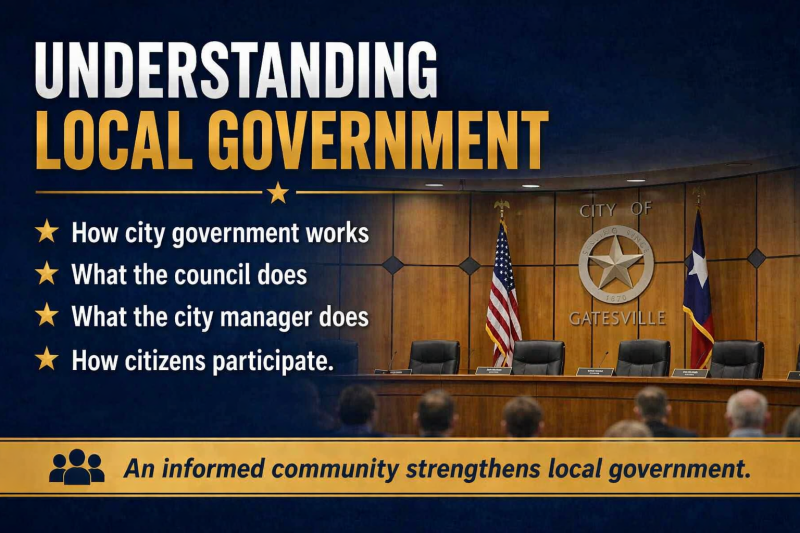
Gatesville operates under a Home‑Rule Council–Manager form of Government
What This Means for Residents:
• The City Council sets policy and adopts the budget.
• The City Manager runs day-to-day operations and supervises employees.
• The Mayor presides over meetings and represents the City but does not manage staff.
• The City Secretary ensures transparency, maintains official records, and posts meeting notices.
Key Legal Safeguards:
• Texas Open Meetings Act requires public deliberation and posted meetings.
• Texas Public Information Act guarantees public access to records.
• Ethics and conflict-of-interest laws apply to all elected officials.
This structure ensures professional management, transparency, and accountability while preventing concentration of executive power in a single elected official.
Citizen Resources
The City Council Citizens' Guide
Prepared by Leo Corona to assist you in preparing to speak before the City Council.
Resources Used:
-
Open Meetings Act Handbook 2026
-
Council Meeting Procedure Policy for the City of Gatesville, Texas (dated January 10, 2023)
Leo’s History of Expressing Concerns at City Council Meetings
Consistency: Leo Corona has attended 13 documented City of Gatesville council meetings between April 2023 and April 2026 — spanning multiple city managers, two election cycles, a major board restructuring, a contentious development vote, and significant infrastructure debates. This is not episodic attendance tied to a single issue; it is sustained civic engagement across a wide range of topics.
Effectiveness: Of 6 speaking appearances, 3 produced fully achieved outcomes, 1 produced a partial outcome, and 2 produced no recorded response or action. A 50% full-achievement rate as a private citizen — with no vote, no staff authority, and no formal standing — is a meaningful benchmark. The two unresolved items (sound board, utility round-up) are not failures of advocacy; they are failures of institutional responsiveness that the record now documents for accountability.
Institutional Knowledge: The engagement record shows progressive depth. In 2023, attendance was observational. By 2024, Corona was presenting to the council as an event organizer. By 2025, he was requesting and receiving a formal committee appointment. By 2026, he was using procedural mechanisms (pulling consent items) to shape how the council handles its own agenda. This is a natural progression from informed observer to institutional participant.
Two Unresolved Items: The auditorium sound board comment (Feb 2026) and the voluntary utility round-up proposal (Mar 2026) both went without institutional response. The sound board is a minor capital item that may yet be addressed in the City Hall renovation scope. The utility round-up proposal is more significant — it was an explicit request for a future agenda item, which is a formal procedural request under Texas Open Meetings practice. A council that has not honored that request within two subsequent meetings has a documented gap in its public responsiveness. If elected, these two items provide an immediate, documented basis for follow-up action.
What This Means If Elected: This record demonstrates the temperament and engagement pattern of a candidate who has spent years learning the institution before seeking to lead it. The HOT Committee appointment, in particular, shows the council already recognized Leo Corona as a trustworthy civic participant. The consent agenda pull on April 28, 2026 — the most recent action in this record — is perhaps the most telling: it reflects someone who understands not just the issues, but the mechanics of how governance can be improved.
Local Government Resources
Publications from Office of the Attorney General and Texas Municipal League, TX | Official Website
A Citizen’s Guide for Speaking Before the City Council
Disclaimer: This is not an official City of Gatesville, Texas document. This reference sheet was independently created using the Texas Open Meetings Act (OMA) and publicly available City memoranda. -by Leo Corona
Canvassing in Texas
Know your rights. Follow the rules. Knock with confidence.
What is political canvassing?
Political canvassing means going door-to-door to talk with voters -- identifying supporters, sharing a candidate's message, encouraging people to vote, and recording what you learn. It is one of the oldest and most effective forms of political organizing, and it is protected by the U.S. Constitution.
-
✓Identifying and surveying voters
-
✓Encouraging voter participation and turnout
-
✓Sharing a candidate's positions on the issues
-
✓Delivering literature and informational materials
-
✓Collecting contact information for follow-up
Is canvassing the same as soliciting?
No. Political canvassing is generally not considered soliciting under federal law. Soliciting involves selling goods or services for commercial gain. Political canvassing is non-commercial speech -- you are exercising a constitutional right, not running a business. This distinction matters when you see a "No Soliciting" sign.
Bottom line for canvassers:
A "No Soliciting" sign does not legally apply to political canvassers in most jurisdictions. A "No Trespassing" or "No Canvassers" sign does -- respect it and move on.
Your constitutional rights
The First Amendment protects political canvassing as free speech. Two landmark Supreme Court cases established this clearly:
Martin v. City of Struthers (1943)
Cities cannot ban door-to-door distribution of political materials. Your right to knock cannot be stripped by a local ordinance.
Watchtower Bible & Tract Society v. Village of Stratton (2002)
Requiring permits before non-commercial canvassing violates the First Amendment. You generally do not need a permit to knock doors for a political campaign.
Rules every canvasser must follow
Identify yourself immediately
When a door opens, state your name and that you are volunteering for the campaign. Wear campaign apparel or carry branded materials whenever possible.
Respect No Trespassing signs
If a property has a No Trespassing or No Canvassers sign, skip it. Do not approach the door. Mark it as Inaccessible in the app.
Leave when asked
If a resident asks you to leave -- even without a sign -- leave immediately and politely. Remaining after being asked to leave can constitute trespassing. Mark the door Refused.
Literature goes on the door, not in the mailbox
Federal law prohibits placing anything in a U.S. mailbox unless it carries proper postage. Leave flyers in door handles, screen doors, or weatherstripping -- never inside the mailbox.
Canvass during reasonable hours
Knock between 9 a.m. and 9 p.m. The Supreme Court has struck down some earlier cutoffs, but staying within this window keeps you above reproach and avoids conflict.
Texas-specific notes
HOAs and gated communities
Homeowners associations and gated communities may restrict access to private streets and common areas. If a guard or gate requires a resident to buzz you in, do not tailgate -- mark those addresses Inaccessible.
Apartment complexes
Apartment property managers can restrict access to common areas. If you are denied entry to a building lobby or hallway, respect it. Individual voters who answer their own door at ground level are generally approachable.
You do not need a permit
Texas does not require a permit for political canvassing on residential streets. Some cities may have local ordinances -- check with your campaign administrator if you are canvassing in an unfamiliar jurisdiction.
No law enforcement notification required
You are not required to notify police before canvassing. If law enforcement approaches you, identify yourself calmly, explain you are a political canvasser, and show your campaign materials.
If your rights are challenged
Occasionally a resident or even a police officer may question your right to canvass. Here is how to handle it:
-
1Stay calm. Do not argue. Your job is to knock doors, not win a debate on the sidewalk.
-
2Identify yourself and show your campaign materials.
-
3If you feel unsafe at any point, leave the area immediately.
-
4Report the incident to your campaign administrator as soon as you are clear.
-
5Serious violations of your rights can be reported to the ACLU of Texas.
Outcome codes in knockTEXAS
Use these when recording each door in the app:
Not HomeKnocked, no answer. Leave lit if you have it.
SpokeHad a conversation. Record support level.
RefusedResident asked you to leave or refused to engage.
MovedA neighbor says the voter no longer lives there.
InaccessibleGated, locked building, aggressive dog, No Trespassing sign.
DeceasedResident has passed away. Confirm with household member.
OtherAnything that does not fit above -- add a note.
Tips for effective canvassing
-
→Walk with a partner when possible -- safer and keeps energy up.
-
→Introduce yourself by first name and the candidate's name in the first sentence.
-
→Ask open-ended questions: What issues matter most to you in this election?
-
→Listen more than you talk. Voters remember how you made them feel.
-
→Do not debate. If someone is hostile, thank them for their time and move on.
-
→Stay hydrated, wear comfortable shoes, and keep your phone charged.
-
→Sync your knocks in the app whenever you have signal -- do not wait until end of shift.
-
→If you finish your turf early, ask your coordinator for another one.